


RM ENGINEERING RACE
RM Engineering GT4+ Pre-Preg Dry Carbon Fiber Swan Neck Wing For BMW G87 M2
RM Engineering GT4+ Pre-Preg Dry Carbon Fiber Swan Neck Wing For BMW G87 M2
SKU:DRMGT4PLSWINGG87160
- 1X 1600 mm GT4+ Pre-preg Carbon Rear-wing Mainplane
- 1 Pair Standard Pre-preg Carbon Flat Endplates
- 1 Pair Swan-neck Wing Uprights
- 1 Pair Vehicle-specific Trunk Mounting Bases
- 1 Pair Shortened Trunk Lid Lift Support/Struct
- 1 Set Complete Installation Hardware
Couldn't load pickup availability
WARRANTY POLICY
WARRANTY POLICY
Warranty & Inspection Policy
All products must be carefully inspected within seven (7) calendar days of delivery.
Any claim involving damage, defects, missing parts, or incorrect items must be submitted within this seven-day inspection period. Claims made more than seven days after delivery will not be eligible for warranty coverage, replacement, return, or refund.
Customers are responsible for inspecting the product and confirming that it is correct, complete, undamaged, and suitable for the intended vehicle before installation.
Products must not be installed if any damage, defect, fitment issue, or missing component is discovered. Please contact us before proceeding with installation.
Once a product has been installed on a vehicle, it is considered accepted by the customer and is no longer eligible for warranty coverage, return, replacement, or refund.
By purchasing and installing our products, the customer acknowledges and agrees to this Warranty & Inspection Policy.


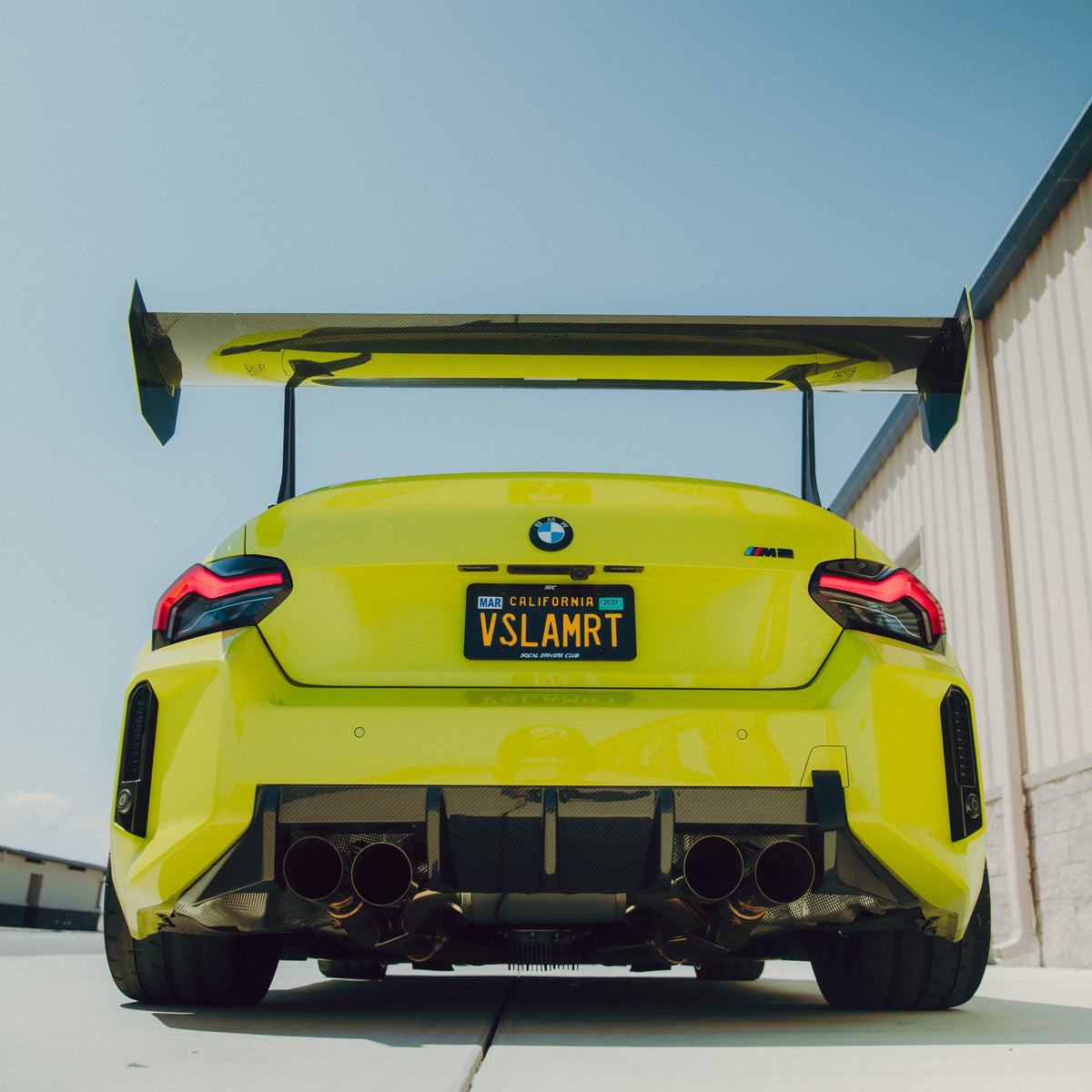
G87 M2 GT4+ Swan-Neck Rear Wing
The RM Engineering GT4+ Swan-Neck Rear Wing is a dedicated rear aero system for the 2023+ BMW G87 M2. It combines a 1600 mm pre-preg carbon fiber mainplane, carbon fiber endplates, swan-neck uprights and G87-specific trunk mounting bases.
In the analyzed installation, full-vehicle CFD reports 245.0 lbf of integrated rear-wing downforce at 120 mph using velocity-squared scaling. The result accounts for the airflow reaching the wing after passing over the G87 M2 body.
Swan-Neck Structure and G87 Mounting
The pre-preg carbon fiber mainplane is supported from its upper surface by swan-neck uprights, leaving more of the lower airfoil surface unobstructed by conventional bottom-mounted stands.
Dedicated trunk bases position the uprights on the G87 M2, while the included shortened trunk-lid lift supports accommodate the completed wing assembly.
Product Features
- Designed specifically for the 2023+ BMW G87 M2
- Pre-preg carbon fiber mainplane
- Pre-preg carbon fiber flat endplates
- Swan-neck wing uprights
- G87-specific trunk mounting bases
- Multiple wing adjustment positions
- Shortened trunk-lid lift supports included
- Full-vehicle CFD-analyzed installation
- Complete installation hardware included
- Professional installation required
Installed G87 M2 CFD Performance
The rear wing was evaluated within a complete BMW G87 M2 full-vehicle CFD model. This accounts for the local airflow reaching the mainplane after passing over the roof and rear glass.

Full-vehicle CFD visualization showing the airflow approaching and passing around the G87 M2 GT4+ rear wing.
| Integrated Wing Result | 100 km/h CFD | 120 mph V²-Scaled |
|---|---|---|
| Downforce | 65.7 lbf | 245.0 lbf |
| Global X-direction drag | 3.3 lbf | 12.3 lbf |
| Downforce-to-drag ratio | 19.87 | 19.87 |
The native simulation was performed at 100 km/h (62.14 mph) with the wing in position 2. The 120 mph figures use a velocity-squared scaling factor of 3.729583 and were not independently simulated at 120 mph.
The reported forces are integrated over the wing surfaces. They do not represent total rear-axle aerodynamic load or a direct stock-versus-modified vehicle comparison.
Rear-Body Flow and Wing Adjustment
Airflow reaching an installed rear wing differs from isolated-airfoil flow. The CFD study identifies slower airflow and separation over the rear glass, which influence the direction and energy of the flow approaching the wing.

Surface-relative velocity showing the rear-body airflow environment approaching the installed G87 M2 rear wing.
The wing provides multiple adjustment positions for changing its setup. The installed CFD configuration is identified as position 2, but the report does not define its corresponding geometric angle. Do not assign a specific angle without the applicable mounting or setup documentation.
Review the complete BMW G87 M2 GT4+ CFD Analysis Report for the simulation methodology and additional results.
Front and Rear Aero Balance
A rear wing changes the vehicle’s aerodynamic load distribution. Track-focused setups should be evaluated together with the front aero configuration rather than treating the rear wing as an isolated component.
For the coordinated GT4+ configuration, pair the wing with the BMW G87 M2 GT4+ Front Splitter Kit and optional G87 M2 GT4+ Carbon Fiber Canards.
Vehicle Fitment
Designed for:
- 2023+ BMW G87 M2 Coupe
- Compatible factory trunk lid
This is not a universal trunk-mounted rear wing. Fitment with aftermarket carbon fiber trunk lids, modified trunk panels or other rear aero components is not confirmed.
Browse the complete BMW G87 M2 aero collection.
Installation
Professional installation and permanent trunk drilling are required. The mounting bases must be measured, aligned and mechanically secured through the trunk lid.
Install the included shortened trunk-lid lift supports as required for the completed assembly. Confirm mounting-point support, trunk operation and adequate clearance before use.
Inspect the uprights, mounting bases, mainplane, endplates and installation hardware regularly, particularly after track use. Do not lift or move the vehicle using the rear wing.